Define the shape
An equation combines radial and angular undulations in a continuous surface.
CREATIO
A NEW KINEMATIC FRAMEWORK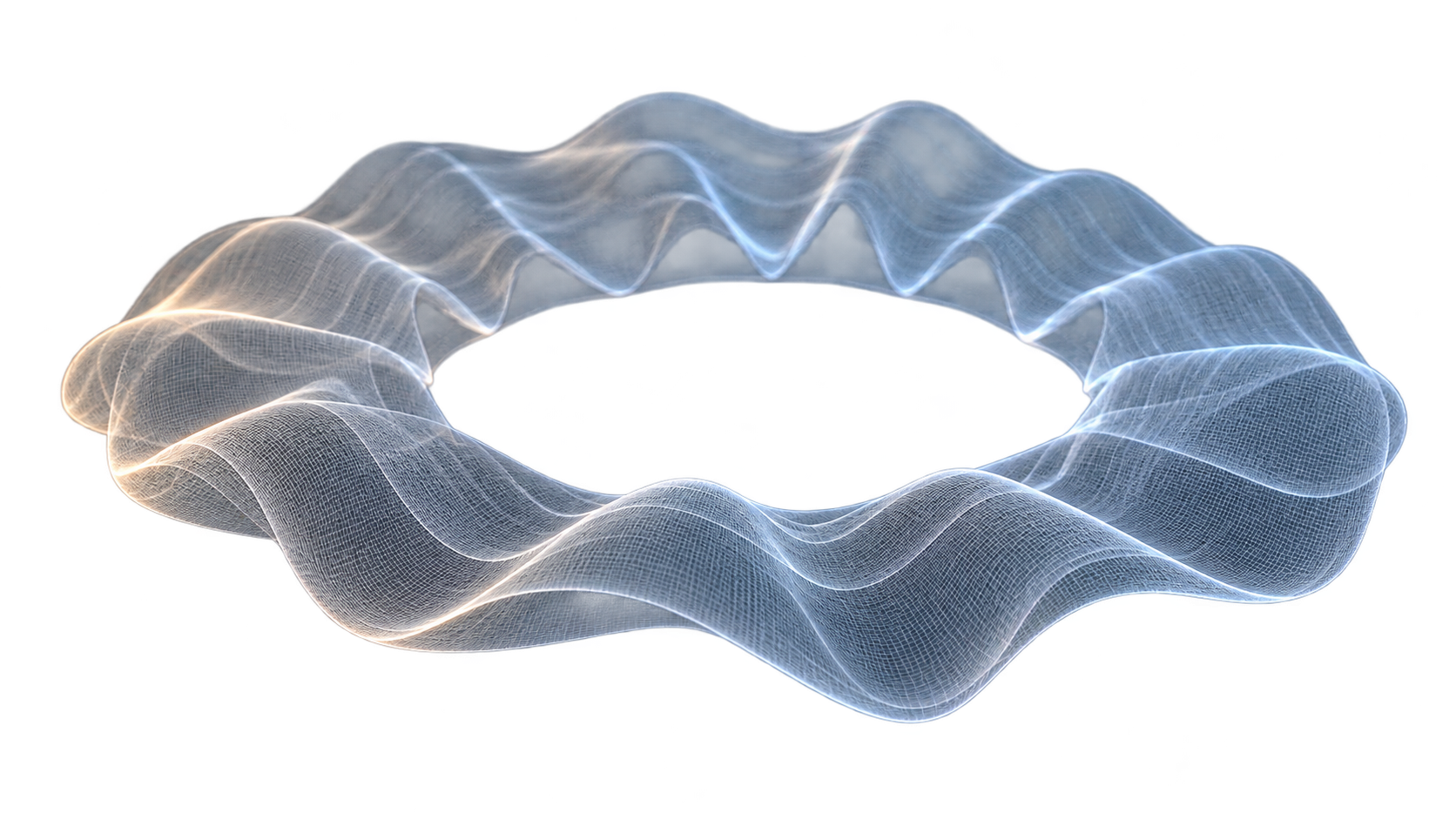
A NEW KINEMATIC APPROACH
A programmable surface.
A new approach to motion.
New horizons for space.
A mathematical surface.
A physical principle.
A broader horizon.
01 — THE CONCEPT
CREATIO explores a circular sinusoidal surface whose shape can vary over time. Its travelling undulations create a rotating pattern without requiring rigid-body rotation of the entire surface.
Successive depressions can guide a sphere along a circular path. The changing contact geometry offers a way to explore mass transport through deformation.
An equation combines radial and angular undulations in a continuous surface.
Changing the phases shifts the pattern of peaks and troughs.
The interaction between the surface and the mass turns deformation into transport.
The CREATIO surface is described by the Cartesian parameterization . The parameter measures distance from the inner radius in the reference surface; is the angular coordinate and denotes time.
The wave profile combines radial and angular components:
The inclination transforms the radial–vertical plane. Defining the projected radius:
In the reference case , this reduces to:
is the amplitude; and are the radial and angular cycle counts. The phases and and the inclination are real-valued functions of time. All angles in the equations are in radians. The visualization controls display degrees and convert them internally.
Angular periodicity follows from : and represent the same position. The inclined family uses .
In the animation, a phase can vary linearly, while inclination can oscillate sinusoidally:
Here, is the phase rate, the oscillation angular frequency and its nonnegative angular amplitude, with . The radial phase can follow the same linear law. These models describe geometric evolution, rather than contact forces.
Change the geometry and animate the deformation. Initial amplitude: A = 0.18, half the previous value. Radii remain fixed: R₀ = 0.68 and R₁ = 2.40, in model units.
The selected phase varies with time; the sliders set its starting value. Inclination animation oscillates around γ with an amplitude of up to 15°. The speed control sets the phase rate or oscillation frequency.
The opening image is a visual interpretation of the concept. This figure is calculated from the equation and does not simulate the dynamics of contact with a sphere.
02 — DEVELOPMENT
One geometric principle. Different ways to make it tangible.
CREATIO SURFACE — The prototype
A solid acrylic structure, brass pins and a metallic sphere. Inside the frame, the rigid CREATIO surface converts rotation of the base into vertical pin movement.
Rotation of the CREATIO surface moves the pins vertically, advancing the supporting cavities. A metallic sphere follows this motion and completes a 360° circuit.
Exploratory dynamic simulation on the CAD model’s pins: a Ø28 mm sphere (≈90 g), gravity and reference friction μ = 0.15. The trajectory results from contact forces; rounded contacts and their compliance are approximated. This numerical result is not experimental validation.
Explore sphere transport in the technical notebook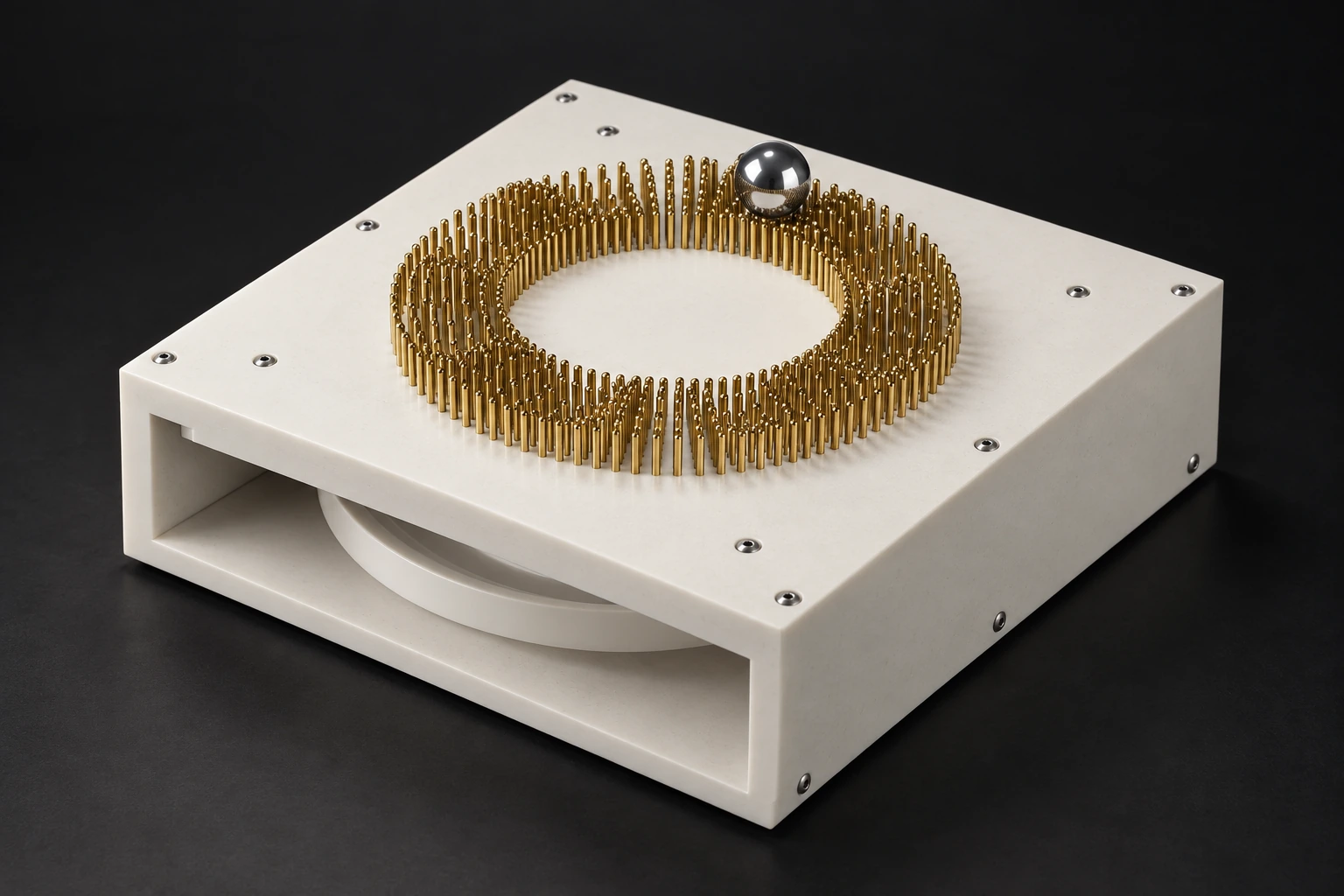
A visualization of the mechanism with the sphere resting on the discrete pin surface.
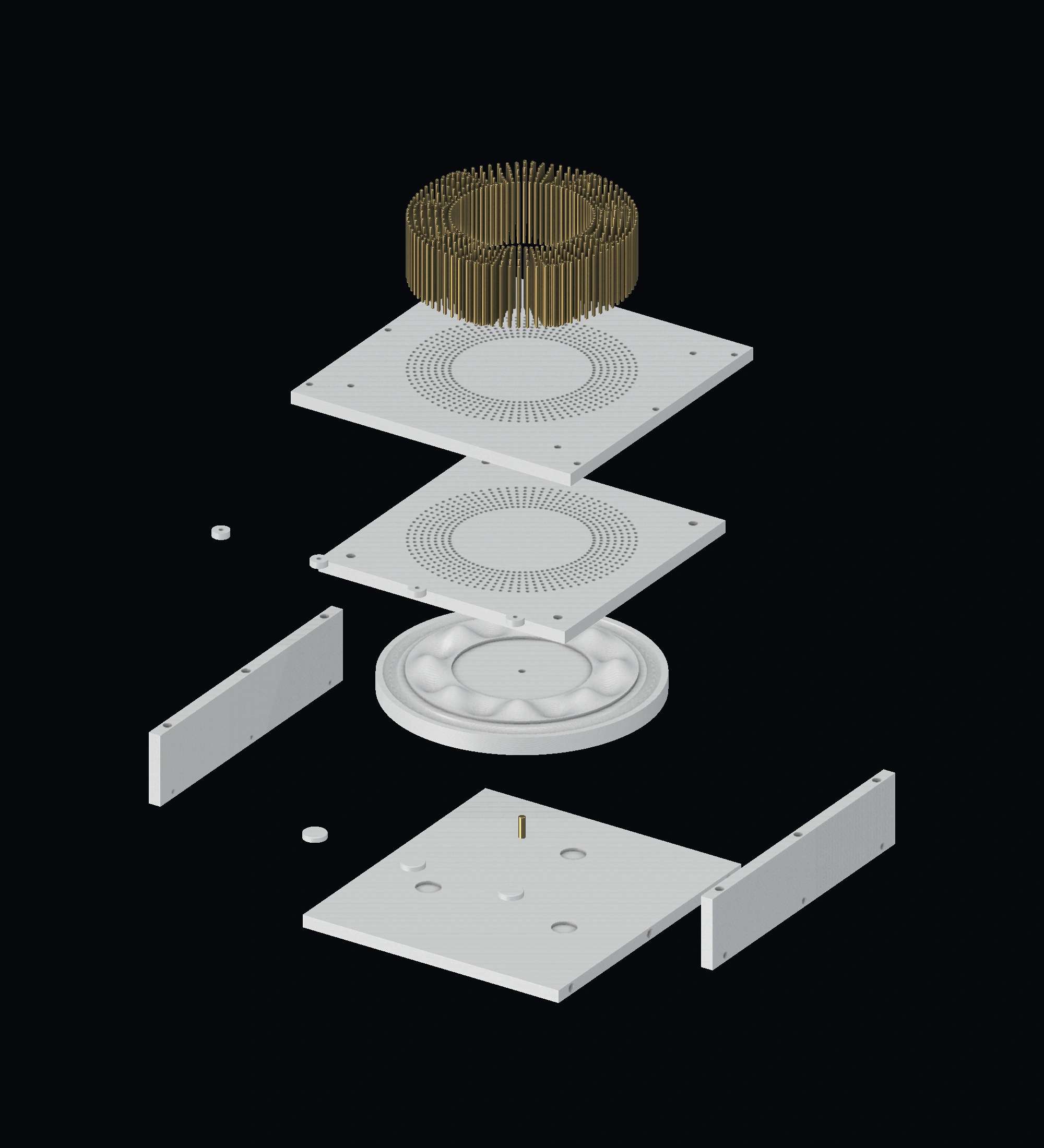
Rendered directly from the 574 STEP solids: 560 pins and 14 components, including both guide plates, the CREATIO surface, shaft, spacers, supports and frame. Parts are separated by translation, preserving their geometry.
Assembled mechanism: illustrative photorealistic visualization. Exploded view: original STEP geometry. The sphere and M4 screws added to the assembled image are not present in that file.
A rigid sinusoidal surface, a perforated plate and an array of pins. Rotating the base moves the pins vertically, reproducing the undulation in discrete form and allowing the transport of a sphere to be observed.
In this mechanism, the base physically rotates. It demonstrates the geometric principle.
A flexible membrane supported by an array of linear actuators. The aim is to control local deformation and reproduce the travelling pattern without mechanically rotating the base.
A research direction exploring controlled membrane deformation without direct mechanical contact between actuator and membrane. Magnetic, electrostatic and acoustic approaches are among the possibilities to be assessed, considering achievable deformation, response time, energy use and suitability for the intended application.
03 — HORIZONS
Study how radial and angular phases can guide trajectories and position masses on a surface.
Investigate the interaction between complementary surfaces and the transfer of motion through their geometry.
Assess the potential of internal mass redistribution for attitude control, respecting conservation of angular momentum.
Proposed research applications. Feasibility requires dynamic modelling, force measurements, energy-consumption analysis and experimental validation.
CREATIO / SPACE APPLICATIONS
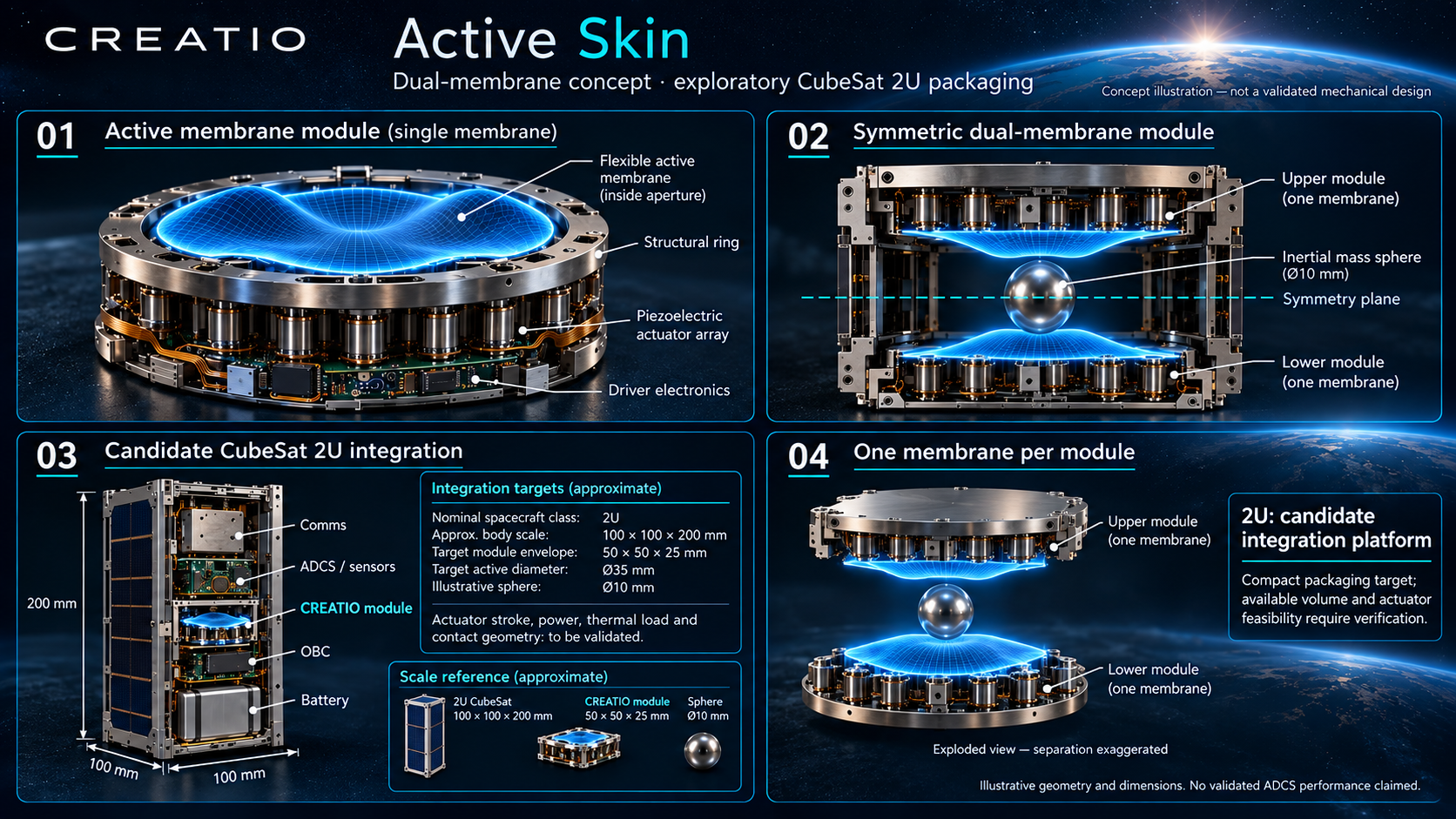
The proposed space architecture uses two synchronised Active Skin membranes, symmetric about the plane through a confined spherical mass. Piezoelectric actuators would propagate controlled surface deformations to guide the mass. This is a research concept, not a flight-qualified attitude-control system.
A rotating rigid sinusoidal base drives vertically guided pins. The resulting moving cavities illustrate how a sphere can be transported by a changing contact profile. The site includes a mechanism simulation and prototype views; these do not constitute a microgravity or closed-loop attitude test.
See mechanism and simulation →Replace the rotating base with two stationary, programmable membranes and a controlled actuator array. Symmetric confinement is proposed to maintain contact with the sphere in microgravity. Actuation, sensing, thermal behaviour and achievable travel remain to be engineered.
Explore technology concept →Internal mass motion can exchange angular momentum with the spacecraft structure, but cannot change the total angular momentum of an isolated spacecraft. Useful, repeatable reorientation, power demand and momentum management require a coupled dynamic model and measurements.
Review related research →CREATIO ACTIVE SKIN / CUBESAT 2U
Two opposed modules, each with a single active membrane facing the sphere. The exploded view distinguishes the membranes, actuators and supporting structure.
TECHNOLOGY VALIDATION PATH
For technical evaluation or a possible research partnership: contact the project author.
04 — SCIENTIFIC LITERATURE
Four priority studies inform distributed actuation, sphere contact, travelling-wave transport and magnetic shape programming. Each implication is a proposed test, not validation of CREATIO.
Nine distinct papers · Updated 25 September 2026 · Four featured, five in the archive
Distributed electromagnetic actuation · Peer reviewed
Nature Communications · 21 September 2026
A six-spoke elastomer with liquid-metal channels used Laplace forces in a static magnetic field. The authors demonstrated more than nine locomotion modes and transitions under 0.35 s.
The skin itself could contain distributed conductors. For CREATIO, test whether this architecture reproduces a controlled local cavity; the paper does not demonstrate a sinusoidal membrane or attitude control.
Sphere contact and preload · Peer reviewed
Advances in Mechanical Engineering 18(9) · 8 September 2026
Three travelling-wave stators contact a 150 mm sphere. Flexible 0.4 mm supports and adjustable springs improved contact adaptability; tests reached 42°/s no-load speed and 0.64 N·m stall torque under specified preloads.
For two opposing Active Skins, measure the normal-force window, slip and power as the residual clearance δ varies. These rotor results are a contact-design reference, not a CREATIO performance claim.
Light-programmed surface · Experimental
Nature Communications 17, 3613 · 2026 · Peer reviewed
UV and visible light reshape a thin hydrogel in real time. The authors transported a 5 µm glass sphere 25 µm in 25 s and demonstrated a travelling-wave conveyor for multiple particles.
A direct experimental analogue for phase-controlled surface transport. Test whether a moving CREATIO cavity can maintain confinement while the wave advances; the micrometre, liquid-assisted result does not establish performance for a macroscopic sphere.
Magnetic membrane · Experimental preprint
arXiv:2606.21716 · June 2026 · Preprint (not peer reviewed)
A patterned NdFeB–PDMS membrane formed a reversible sinusoidal profile under an external field. The authors measured the shape by optical profilometry and demonstrated mixing in a microchannel at 2 Hz and up to 120 mT.
Suggests a route to fabricating and measuring a contactlessly actuated sinusoidal membrane. The reported tests concern fluid mixing at microscale and use a rotating external magnet; they do not demonstrate circular transport of a sphere or spacecraft attitude control.
TRANSLATING THE BRIEFING INTO TESTS
Retain the CREATIO surface formulation while commanding only the region needed to contain one sphere; keep the rest close to zero amplitude. For two opposed, symmetric skins, use Dsphere = 2A + δ as a working geometric relation and sweep δ experimentally to determine a useful clearance and preload range. This is a CREATIO design hypothesis, not a result of the cited papers.
Aerospace relevance still requires a closed-system angular-momentum balance and measurements per mass, power and volume; no cited paper validates CREATIO as ADCS hardware.
CubeSat · Microgravity experiment · Preprint
arXiv:2501.17173 · 2025
A 3U-scale model executes joint sequences in a drop tower. Measurements enable evaluation and refinement of the dynamic reorientation model.
The closest reference for planning validation of a CREATIO space application: relating internal motion to overall orientation. Its mechanism uses articulated bodies; adaptation to a membrane requires a dedicated model.
Spacecraft · Numerical simulation
Astrodynamics 8, 47–60 · 2024
Studies configuration optimization and joint actuation for attitude control of transformable spacecraft under solar radiation pressure, assessed through simulations.
Provides reference methods for coordinating geometry and control. Solar pressure introduces external forces and torques: the results cannot be transferred directly to a CREATIO Active Skin in an isolated system.
Planetary exploration · Numerical simulation
2025 IEEE Aerospace Conference
Proposes two robots connected by a tether. Predictive control adjusts limbs and tether length to modify moments of inertia and stabilize orientation during low-gravity jumps.
Helps frame mass redistribution as a control variable. It can inform modelling of masses transported by CREATIO, although it studies articulated robots rather than a sinusoidal surface.
Flexible active skin · Experimental
Nature Communications 16, 5575 · 2025 · Peer reviewed
A 12-protrusion pneumatic skin generated translation and clockwise/counterclockwise motion through phased inputs. In tests, a 2.94 g actuator transported a 227 g object; visual feedback guided complex paths.
A useful benchmark for phase sequencing, contact, load and closed-loop tracking in a bench prototype. Measure force, slip and path error against this class of device; pneumatic operation and friction-dependent transport differ from the proposed CREATIO geometry.
Mechanical memory · Peer reviewed
Physical Review E 114, 035508 · 17 September 2026
Symmetric bistable pneumatic shells retained discrete states. Three coupled actuators accessed all eight global states in numerical and experimental validation.
Suggests a possible way to hold dormant areas without continuous power. Applying this to a moving CREATIO cavity remains an architectural hypothesis.
05 — ORIGIN OF THE CONCEPT
CREATIO grows out of a design practice in which mathematics connects design intent with manufacturing precision. Before becoming an investigation into motion, it was a way of thinking about and building surfaces.
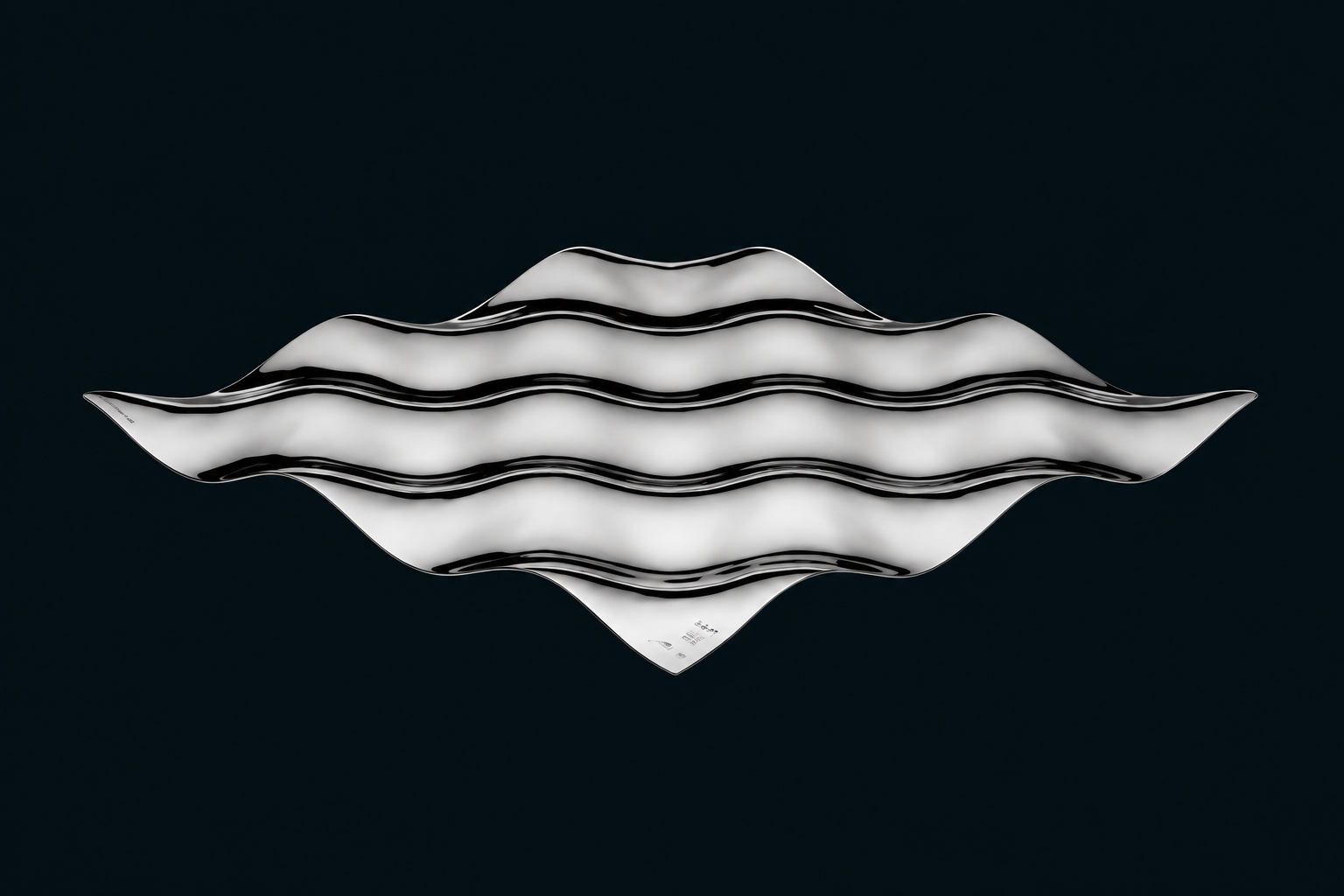
The Unda form was first presented to the public as part of the first edition of the “Remade in Portugal” project in 2007. The piece prompted the mathematical exploration of the surface. Photograph supplied by the project author; background adapted for this presentation.
While developing the Unda piece, Álvaro Siza asked Pedro Simões to define a surface from four sinusoidal boundary curves. The challenge was to construct its interior geometry and find the right proportions while retaining the freedom to adjust the shape throughout the design process.
The response was to describe the surface through an equation with shape parameters. Adjusting these parameters made it possible to explore a family of geometries without rebuilding every model. This led to the Design Math Approach (DMA), a methodology developed by Pedro Simões to connect a piece’s mathematical definition with its manufacture.
The methodology extended to machining toolpaths and parametric G-code programming. Custom Java/JavaFX applications made it possible to visualize surfaces, adjust parameters and check the relationship between geometry, cutting tool and manufacturing path. In selected applications, machining code could be exported directly.
A further exploration involved curving the Unda surface through 360 degrees and formulating the resulting annular geometry: the CREATIO Surface. The next step was to introduce time into its parameters. As the angular phase changed, the wave pattern appeared to rotate, although the transformation could be described as an evolution of shape.
This observation led to the idea of a membrane whose programmed deformation could guide a mass along a circular path. A demonstrator using a rigid surface, a perforated plate and pins enabled physical exploration of the principle. CREATIO Active Skin and magnetic actuation extend this research towards replacing base rotation with local deformation control.
06 — THE AUTHOR
DESIGN ENGINEER · MECHANICAL ENGINEERING · INDUSTRIAL DESIGN
Rui Pedro Oliveira Simões works at the intersection of engineering, design and production. His background combines the analysis of physical systems, mathematical modelling and direct experience of turning ideas into objects, prototypes and manufactured pieces.

1995 — 2001
Faculty of Engineering, University of Porto — FEUP
Degree in Mechanical Engineering, specializing in Fluids and Heat. His final-year project addressed the energy self-sufficiency of a mountain shelter through the use of locally available energy sources.
2004 — 2007
FEUP + ESAD
Research into the use of wood powder to produce prototypes through additive manufacturing principles. The work connected materials knowledge, production processes and design experimentation.
2001 — 2003
INEGI · Porto
As a junior technical engineer, he worked on the installation and maintenance of meteorological measurement equipment, remote data transmission and time-series processing. He contributed to wind-resource assessments and wind-farm feasibility studies, connecting field measurements, analysis and technical evaluation.
SINCE 2003
SPSS, Lda. · Vila Nova de Gaia
At SPSS, his work spans the product development cycle: interpreting the concept, 3D CAD modelling, prototyping, technical preparation and production. His coordination of multidisciplinary projects includes collaboration with Álvaro Siza Vieira, Eduardo Souto de Moura and other Portuguese and international architects.
Integrating CNC machining and laser technology into production, programming equipment and developing parametric models are central to this experience. His work involves wood, metals, cork and composites, combining digital processes with workshop expertise.
A co-founder of SPSS Design Studio, he contributes to the conception and technical execution of the “S.” line of collectible furniture, design objects and sculptures. He also develops Java/JavaFX applications and algorithms that support design, production organization and manufacturing control.
CREATIO emerges from this experience across drawing, calculation and manufacturing: an independent investigation in which the equation is both a tool for exploring form and a starting point for studying movement.
Form as a starting point.
Movement as a possibility.